A Local's Guide to Castle Ruins Along the Welsh Marches
EXCERPT: A practical route through the quieter castles of the Welsh Marches — no turnstiles, no tearooms, no coach parties, just tumbled curtain walls, nettles and a wind that has been blowing across the same ridge since 1277.
I grew up about twenty minutes from the border, which means I grew up assuming that every hill had a castle on it and every village had at least a mound. Mostly that's true. The Marches — the long, contested strip either side of the England–Wales border, running roughly from Chester down to Chepstow — hold one of the densest concentrations of medieval fortification in Europe, and the great majority of them are free, unstaffed and entirely empty on a Tuesday morning in October.
This is a guide for people who would rather have a ruin to themselves than a good audio guide. The route runs north to south, but it works in reverse, and you can break it into three or four day-sized pieces without much trouble. Bring boots, a paper map and cash for the pub, because the signal is patchy and the card machine is frequently "resting".
What Actually Counts as the Marches
The Marches were not a single border but a zone of lordships — the so-called March of Wales — where Norman and Anglo-Norman families were given wide licence to hold land and build as they pleased. That is why you find a castle every four or five miles rather than every forty. It is also why the architecture is so varied: a great stone keep at Grosmont, a moated enclosure at White Castle, a lonely motte above a Radnorshire stream, all within an hour of each other.
Practically, for this guide, the Marches means the band from Ludlow and Clun in the north, through Montgomery and the upper Severn, down past Knighton and Presteigne, across to Hay-on-Wye, and south to Abergavenny and the Usk valley. Everything below sits inside that band.
Before You Set Off: Ground Rules That Save an Afternoon
- Check opening seasons. Free Cadw and English Heritage sites in this region are usually open daily, dawn until dusk, with no facilities. Staffed sites such as Tretower keep seasonal hours and charge admission.
- Assume no facilities. No toilets, no bins, no water. The nearest village is often a twenty-minute drive.
- Wear boots, not trainers. Even a short walk to a motte usually involves wet grass, a stile and a slope.
- Take a paper map. Ordnance Survey Explorer sheets cover the whole route; phone coverage in the Olchon Valley and above Cefnllys is close to nonexistent.
- Pack for four seasons in one walk. The western slopes catch the rain first and hold it longest.
- Check for livestock. Sheep are everywhere, cattle are common on riverside pasture, and dogs belong on a short lead from March to July.
The Route, North to South
Montgomery, Dolforwyn and the Severn's Edge
Start in Montgomery, where the castle sits on a crag above a town of black-and-white houses and a very good deli. Begun in the 1220s under Henry III, it was slighted by Parliament after 1644 and never rebuilt, which is precisely why it feels so raw — big shards of wall, a rock-cut well, and views across to the Long Mountain.
Then drive the few miles to Dolforwyn Castle, the native Welsh counterweight, built by Llywelyn ap Gruffudd in the 1270s and taken by Roger Mortimer within four years. It is a stiff walk up from Abermule through oak woods, and it is usually just you and the buzzards.
Clun, Hopton and the Shropshire Reaches
Clun Castle is a vast motte-and-bailey above a river crossing, with a broken tower to scramble around. It is free, it is English Heritage, and it is the sort of place that makes children run in circles for an hour. Twenty minutes away, Hopton Castle is a single surviving tower in a field — small, but with one of the grimmest stories in the region attached to it, from the siege of 1644. A volunteer trust keeps it open; there is an honesty box and a bench.
The Three Castles: Skenfrith, Grosmont and White Castle
These three are the heart of any serious week, because they were run as a single lordship and you can visit all of them in a day. Skenfrith is the prettiest, tucked beside a village and a river. Grosmont has the finest masonry — a great hall block and a chimney that still stands to full height. White Castle is the largest and quietest, a moated enclosure high above the Monnow with barely a tree to interrupt the view.
Longtown, the Olchon and the Black Mountains
Longtown Castle is my favourite on the whole border: a cylindrical keep on a motte, a set of earthworks you can walk along, and a valley behind it that feels genuinely remote. Follow the lane up the Olchon to Llanthony and you will understand why medieval monks chose the spot and why medieval soldiers kept fighting over it.
Hay, Clifford and the Wye
Hay Castle has been transformed in recent years, with a gallery, a courtyard and a café inside a Jacobean mansion wrapped around a Norman keep — a good wet-weather stop. A few miles downstream, Clifford Castle sits on private farmland and is best seen from the lane or from the riverside footpath. It is traditionally linked with Fair Rosamund, mistress of Henry II, which is the sort of story nobody here lets the facts spoil.
Tretower, Crickhowell and the Usk
Finish in the Usk valley. Tretower is the one site on this list worth paying for: a round keep, a ruined castle and a remarkable restored medieval hall, all in a single walled enclosure. Then drop down to Crickhowell, where a fragmentary castle stands behind the town beside a thirteen-arch bridge across the Usk.
If You Only Have One Day
- Morning: White Castle, because you will have it to yourself.
- Late morning: Skenfrith, for the church and the stonework.
- Lunch: a pub in Grosmont, followed by the castle.
- Afternoon: Longtown, then the drive over the Gospel Pass if the weather is kind.
Reading the Stones: What You Are Actually Looking At
A little vocabulary turns a pile of rubble into a story. A motte is the artificial mound, usually Norman and often built in a matter of weeks by conscripted labour. A bailey is the enclosed yard beside it, where the stables, kitchens and garrison lived. A keep is the last refuge, and a curtain wall is the perimeter that makes the whole thing a castle rather than a house with anxiety.
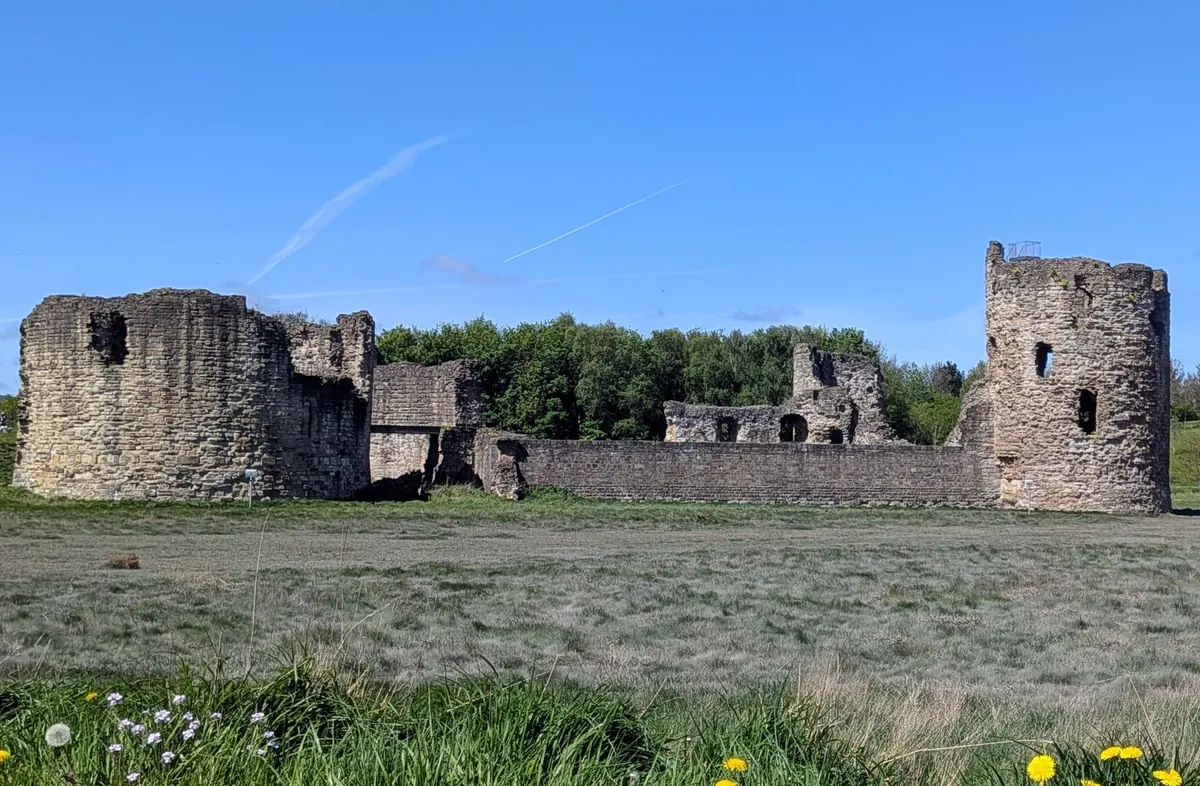
When you see a tower standing alone in a field, ask what happened to the rest. Usually the answer is demolition, or stone robbery — the walls of the nearest farmhouse are often the walls of the castle, re-used. When you see a site with a moat and no masonry above head height, you are looking at somewhere that was abandoned early, often because the border moved and the money moved with it.
Ask anyone in a Marches pub why there are so many castles within sight of one another and you'll get more or less the same answer: you built one to hold the crossing, your neighbour built one to hold the road to it, and then somebody built a third to keep an eye on both of you.
Where to Stop: Pubs, Provisions and Beds
Bases that work well are Ludlow, Hereford, Abergavenny and Hay-on-Wye — all with reasonable food, decent beds and easy access to the route. Hay and Crickhowell are the best bookshops-and-boots combination. Ludlow and Abergavenny are the best for a proper dinner after a day in the mud.
Village pubs along the way open and close with alarming regularity, so ring ahead rather than pin your hopes on a specific one. Shops worth knowing about: Hay for deli supplies, Crickhowell for a proper butcher, Montgomery for a bakery, Clun for a small village store. The rule of thumb in this part of the world is simple — eat when you see somewhere open, because the next place may be shut until Thursday.
Etiquette, Safety and the Small Print
- Stay off private land. Clifford, Brampton Bryan and several others are private or only partly accessible. Use the public footpath and the road, and never climb a fence to reach a mound.
- Do not climb loose masonry. It looks solid and it is not. Every year someone brings a wall down on themselves.
- Take your litter home. There are no bins at any of the free sites.
- Close gates behind you, even if they were open when you arrived.
- Watch for adders on sunny banks between March and September, and check for ticks after walking through long grass.
- Give the ruins to the next person. These sites survive because thousands of visitors treat them gently. A ruin you can wander through freely is a rare thing, and it stays that way only if everyone behaves.
Go in the shoulder seasons if you can. In May the bluebells are out along the Olchon and the walls are still cool; in October the bracken turns and you can see three castles from one ridge. In high summer it is often just as good, provided you start early and accept that the nettles have opinions.
And when you find yourself alone on a motte with nothing but wind and a view, that is not a gap in the experience. That is the experience. Take a moment, then go and find the next one — it will be about four miles away.
Photo: Sophie Caroline / Pexels